

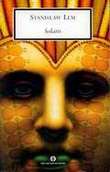
Solaris
( 16 Votes )
image

»Solaris ist der berühmteste Science-Fiction-Roman des Polen Stanislaw Lem. Ein Meisterwerk des modernen utopischen Romans, logisch im Aufbau, verständlich trotz der komplexen technischen und biologischen Materie, packend und spannend erzählt. « (Oberösterreichische Nachrichten)

Der Roman behandelt eines der zentralen Themen Stanislaw Lems: die Möglichkeit völlig fremden, dem menschlichen nicht mehr vergleichbaren Bewusstseins, völlig fremder Systeme intelligenten Lebens, völlig fremder Existenzformen und die Auseinandersetzung mit ihnen. Der Roman imaginiert die jahrzehntelangen Versuche einer zukünftigen Menschheit, eine Lebensform zu ergründen, die wie ein riesiges Meer aus Plasma einen ganzen Planeten erfüllt. Der lebende Ozean vermag es, die geheimste Schuld von Menschen in deren Psyche ausfindig zu machen und zu reproduzieren. Im Falle des Erzählers ist es der Tod seiner jungen Frau, an dem er sich schuldig fühlt.

Kommentare
Neuer Kommentar Suche
Lem's visionary depiction of contact
Virgil Y-m-d H:i:s

One note readers should know beforehand is that the version of Solaris available in English is a translation from Polish to French and then translated from the French into English. For some irresponsible and bizarre reason, publishing house Faber and Faber who own the license have not authorized a direct from Polish translation of Solaris. The good news is that despite this the translators from the French have a good sense of literary style and did a fine job of making it readable and enjoyable, though obviously not as accurate a translation as could be.

At first glance Solaris seems hard science fiction. Set in the future after man has explored many systems the main character arrives at the space station orbiting the planet Solaris. Lem lets us know several things up front, the planet is suspected of being an intelligent life form and there is a long history of exploration, strange happenings and accidents that have occurred. By the time Kelvin arrives after almost two hundred years of study only a small team is left to record and study the planet.

More than hard science is really at the heart of this novel. There are musings on alien contact and the nature of what is intelligence. Is man really the measure of everything? As events occur, Kelvin the rational scientist succumbs to those most irrational of feelings, love and longing. Ironically, Kelvin, the person sent to investigate the occurrences among the crew is the one who is emotionally effected the most by the visitors that accompany everyone.

The genius of the novel is that the visitors are reflections or copy's of each individual in each person's memory. Every character is touched (or disturbed) on a level much deeper than a more conventional alien contact approach. Few readers will fail to imagine who from their own memories would take the form of their own visitor.

This is one of the most intelligent science fiction novels I've read in a long time. The story ends up not being about science but about what makes us human, what is intelligence and what may separate us from another life form. Moving, well written and highly recommended.

link:http://www.amazon.com/review/R1EK504CWYY1TV/r ef=cm_cr_rdp_perm
Incommunicability or Being In the World
Thomas M. Seay Y-m-d H:i:s

This novel explores the theme of communication. Scientists explore a curious planet, Solaris, whose ocean appears to be an intelligent life-form. Scientists are sent to live on the planet
for purposes of establishing contact.

Contact is elusive however. What is to be the medium of communication? Even without the tool of verbal language, humans can empathize and communicate to some extent with other mammals. We know that they share common instincts and emotions with us, such as fear, sex drive, hunger, etc. But what about something so "other" as this solarian ocean?

Finally indisputable evidence of contact arrives. Solaris is able to tap into the scientists brains and create exact replicas of significant persons from their past. These replicas look and act in the same way as the people they simulate. The main character Kelvin has before him Rheya, an ex-lover who had committed a suicide which he could have prevented.

This leads to another problem of communication: how to understand the intentions of this action? Has Solaris created the simulacra as a cruel joke, Or did Solaris do this to please the visitor? Is Solaris just doing it as a kind of experiment?
The scientists are tempted to judge the planet according to human behavior, but realize that would be folly.

Humans view others, not just Solaris, but any other species, or even any other human being through the prism of their subjectivity. To reach the other requires an incredible effort of will...it may be impossible. Kelvin is at once in love with the succubus and tormented that "she" is not really Rheya, in spite of the resemblance. The succubus is evertyhing that Rheya was to Kelvin because she is nothing but a collection of his memories. Fine, but who was the real Rheya? Just a scattered collection of a few bits of the real Rheya mixed in with Kelvin's own desires, fantasies, and fears. So this raises the question of how possible it is to go beyond ourself to another human being.

Another problem raised is that of self-communication. Another scientist in the book, snow, makes the point that humans only know about two percent of their thoughts and that Solaris probably knows more about them than they do themselves.

We humans do seem "walled off" and communicability at this stage of our evolution is pretty minimal. Science does seem a valiant attempt to get beyond our fears and fantaises, but as philosophers of science have proven, even our science is fraught with subjectivity. As for understanding ourselves, as Terence Mckenna say, the various schools of psychology sound like medieval hawkers.

Or is this seperateness all an illusion as Heidegger and some mystics claim? The difference between subject and object was reinforced by cartesianism. In that case, how to overcome the symptom of a seperated, isolated ego?

This is not the place to attempt an answer. However, this book will give you a lot to think about. I recommend that it be read at least two times succesively. You will probably miss many of the finer points during your first read. The time spent on careful readings of this book will reward you with many interesting ideas to ponder.

link:http://www.amazon.com/review/RU8CTVY3EP5FZ/re f=cm_cr_rdp_perm
Kommentar schreiben
Name:
E-Mail:
 
Titel:
Bitte geben Sie den Anti-Spam-Code aus diesem Bild ein.