

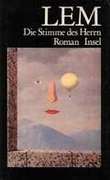
Die Stimme des Herrn
( 9 Votes )

Jakob Gafarelli, der Bibliothekar Ludwigs XIII., fasste die Psalmworte »Coeli enarrant gloriam Die« wortwörtlich auf: die Sterne seien in Form hebräischer Buchstaben am Himmel angeordnet und man könne in ihnen wie in einem Buche alles lesen, was auf der Erde vorgeht. Dass die Himmel den Schöpfer unmittelbar rühmen, davon kann in Stanislaw Lems Roman Die Stimme des Herrn keine Rede sein; die Sterne geben jedoch Zeichen, und wie stets liegt es am Menschen, sie zu deuten. Ein pulsierender Neutrinostrahl aus einer Quelle, die mit der Kraft unserer Sonne sendet, ist entdeckt worden, aber was diese Signale bedeuten, das ist die Frage. Handelt es sich um ein rein physikalisches Phänomen? Oder aber um eine interstellare Botschaft, ausgesandt von einer uns weit überlegenen Zivilisation an bestimmte oder auch unbekannte Empfänger, das heißt alle Zivilisationen, die fortgeschritten genug sind, sie zu entziffern? Gewisse Anzeichen sprechen dafür. Vom Pentagon überwacht, entsteht in der amerikanischen Wüste das Projekt MAVO und damit etwas, dessen Parallele zum Manhattan-Projekt, das zur Entwicklung der Atombombe führte, unverkennbar ist. Teilerfolge bei der Entzifferung des Signals scheinen die Hoffnungen der Militärs zu bestätigen.

Kommentare
Neuer Kommentar Suche
A difficult, but rewarding read...quite unlike any
John Gossman Y-m-d H:i:s

"His Master's Voice" is written as a brilliant mathematician's account of working on a Manhatten Project-like attempt to decipher a signal from space. The attempt has only succeeded in deciphering a tiny fragment of the message (and that is not well understood). Thus the work fits in with Lem's many writings on the subject of the "alien" and how it may be impossible to understand something which is truly different from us. These other works include "Fiasco", "Eden" and (most famously) "Solaris". "His Master's Voice" is the most realistic and the most philosophical in tone. The tale is set in cold war America, and includes a fairly pedestrian plot line around the possibility the signal contains instructions for a weapon, but the bulk of the book consists of the narrator's fundamental observations on life and the universe. The book in fact starts out quite difficultly with a dense introduction and first chapter full of allusions to modern philosophy before starting to tell the "story". Do not be put off by this initial section...it is certain no adventure thriller, but the book does become more approachable and at the same time remains very thought provoking.

I have always suspected Carl Sagan read this book before he wrote "Contact" as the high concept remains...

link:http://www.amazon.com/review/RMJD7RQZAP19T/re f=cm_cr_rdp_perm
Kommentar schreiben
Name:
E-Mail:
 
Titel:
Bitte geben Sie den Anti-Spam-Code aus diesem Bild ein.